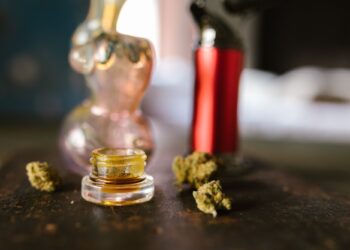
It’s often believed that inhaling more cannabis will create more intoxication and get you higher. However, a new study out of the University of Colorado says otherwise, going as far as to say that even high concentrations of tetrahydrocannabinol (THC) — such as those found in concentrates like dabs — don’t necessarily make users more intoxicated. [1]
The study observed 121 participants, each of whom consumed cannabis on a regular basis. One group of the participants (66) regularly used concentrates whereas the other group (55) regularly used cannabis flower. Overall, about half of the participants were women. The group participants were respectively given either flower or concentrate. The researchers randomized the selection of the two categories of cannabis products—flower contained an average of 16% or 24% THC while concentrates contained an average of 70% or 90% THC.
Due to federal laws surrounding cannabis, Bidwell and her team were unable to evaluate cannabis users through the university. This forced her to develop two mobile vans that went directly to participants’ homes to perform evaluations. [1]
Each test evaluated the user’s blood content, mood, cognitive function, and intoxication level. After obtaining baseline measurements, evaluations were performed at three separate points: right before use, directly after use (ad libitum), and an hour after use.
The group that used cannabis flower had THC levels that spiked to 455 micrograms per milliliter directly after use. The concentrate group spiked to 1,016 micrograms per milliliter. While higher doses produced notable differences within the body’s reaction to THC, there was little difference in terms of impairment. Regardless of their THC levels, both groups had extremely similar cognitive functions along with self-reports of their intoxication.
One of the most notable results from the testing was that the participants’ balance (sway with eyes closed) was about 11% worse after using cannabis. And while their memory (delayed recall) suffered while intoxicated, this effect usually faded away an hour after consumption.
“Surprisingly, we found that potency did not track with intoxication levels,” notes Cinnamon Bidwell, one of the study’s lead authors and an assistant professor at the Institute of Cognitive Science. “While we saw striking differences in blood levels between the two groups, they were similarly impaired.”
“People in the high concentration group were much less likely compromised than we thought they were going to be,” explains Kent Hutchinson, co-author and a professor of psychology and neuroscience at CU Boulder. “If we gave people a higher concentration of alcohol, it would have been a different story.”
References
[1] Bidwell CL, et al. Association of naturalistic administration of cannabis flower and concentrates with intoxication and impairment. JAMA Psychiatry. 2020;77(8):787-797. [Impact Factor: 17.471; Times Cited: n/a]