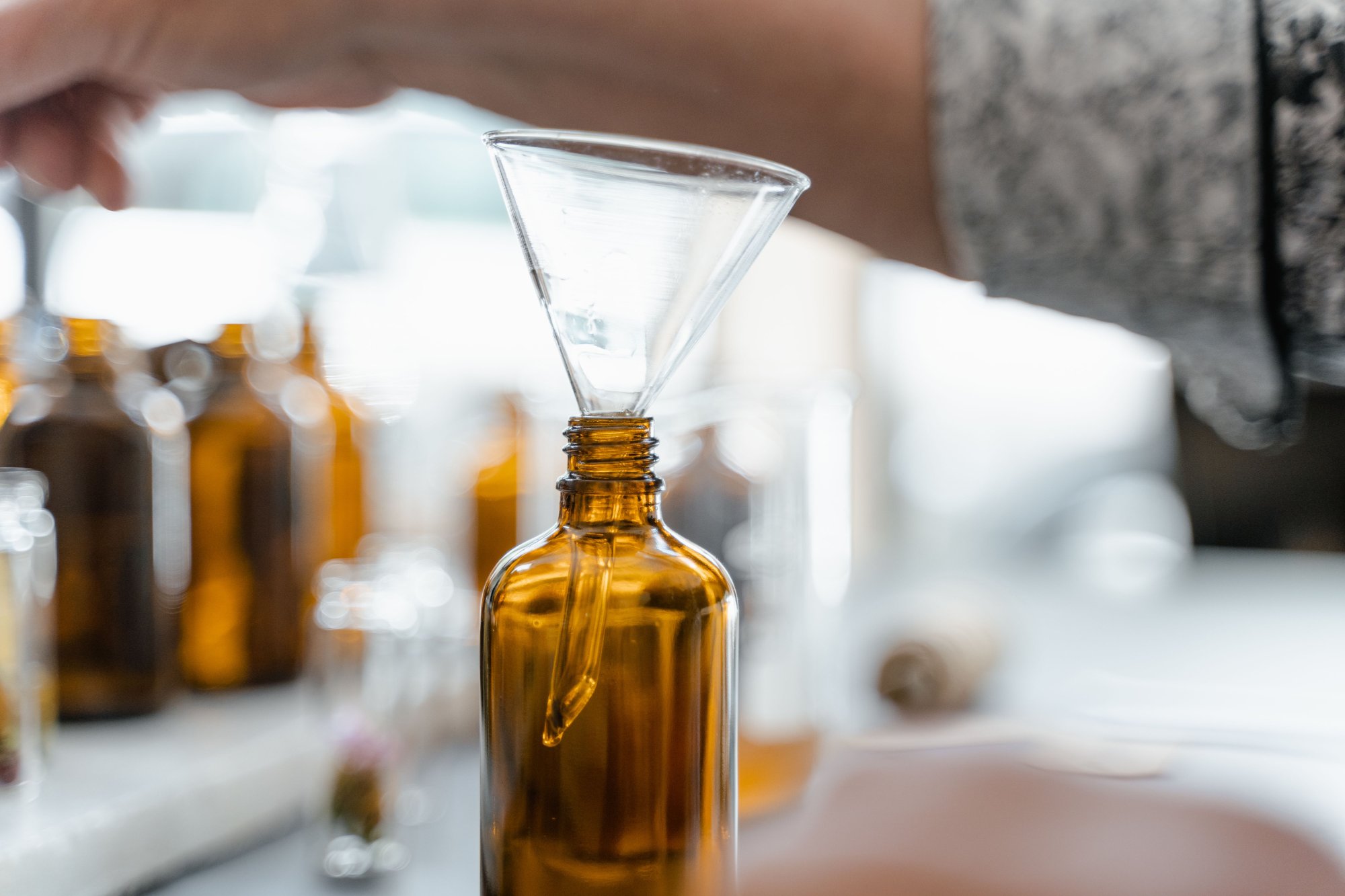
Every steam distillation run makes two products whether the plan accounts for them or not. The oil that separates on top of the receiver gets the attention, the spec sheet and usually the capital budget. The water underneath, which carries a small fraction of dissolved aromatic compounds, often gets poured down a drain or bottled with little more than a filter and good intentions.
That gap is where facilities get into trouble. Essential oil and hydrosol look like two outputs of one process, but they behave like different product classes. One is a hydrophobic, flammable, shelf-stable liquid. The other is mostly water, which is exactly what microorganisms need. Decisions about floor plan, drains, finishes, boiler capacity and record keeping all depend on which stream you intend to sell, and how seriously you intend to treat the other one.
So the question for owners and plant managers is practical: should you build around essential oil, around hydrosol, or around both, and what does each choice commit you to later? This guide walks through the six areas where that choice shows up, and for each one sets out the decision, why it matters for compliance down the road, and the mistake that tends to prove expensive.
The Two Streams at a Glance
Before the facility decisions, it helps to be precise about what each product is. In steam or hydrodistillation, hot vapor carries volatile plant compounds out of the biomass. The vapor condenses, and the distillate separates into two phases. The immiscible oil phase is the essential oil. The water phase, which holds trace volatiles and some water-soluble components, is the hydrosol, sometimes called a hydrolat or floral water. Some oils sit denser than water and sink, which affects receiver design, but the principle holds.
| Factor | Essential oil | Hydrosol |
|---|---|---|
| Base | Concentrated volatile fraction | Water with dissolved trace volatiles |
| Main hazard | Flammability, handling of concentrated material | Microbial growth |
| Stability | Generally stable if protected from air, heat and light | Shorter shelf life, sensitive to contamination |
| Storage | Flammable liquids controls, sealed containers | Cold or controlled storage, hygienic closed containers |
| Typical testing | Chemical profile, identity, purity | Microbial counts, pH, identity, preservative effectiveness where used |
| Yield per run | Small | Large |
| Sanitation burden | Moderate | High |
Notice that yield runs in opposite directions from risk. The hydrosol volume per batch is usually far larger than the oil volume, which means a facility that ignores it still has to move, hold or dispose of a lot of water. That reality is the reason to decide on purpose.
1. Layout and Flow
The choice
You can treat the hydrosol as waste, as a bulk intermediate sold or used within your own operation, or as a finished packaged product. Each option implies a different floor plan.
- Oil only: A conventional receiving, distillation, separation, oil polishing and drum or bottle storage line. Hydrosol goes to a holding tank for treatment or disposal.
- Oil plus bulk hydrosol: The same line plus a dedicated, closed transfer route from the receiver to a sanitary holding vessel, with its own sampling point.
- Oil plus packaged hydrosol: A separated filling area with controlled access, finishing and filling equipment, packaging staging and clean storage, ideally with a one-way flow from raw biomass to finished goods.
Why it matters later for compliance
Inspectors and auditors read a floor plan as a statement of intent. Product that is meant for sale to consumers, whether as a cosmetic, a flavoring or a supplement ingredient, falls under good manufacturing practice expectations that assume you have prevented cross-contamination by design. Raw biomass, spent plant material and wet processing areas are contamination sources. A hydrosol filling area placed next to a biomass dump station is hard to defend with procedures alone.
The costly mistake to avoid
Designing the building for oil and then adding hydrosol bottling in whatever space is left. Retrofitting a hygienic zone means new walls, new drains, new air handling and often a new traffic pattern for staff. Even if you start with oil only, reserve the footprint, utility stubs and a clean route for the hydrosol option.
2. Sanitation
The choice
Decide the sanitation standard for each stream separately. Essential oil handling calls for clean, dry, well-maintained equipment and a cleaning method that actually removes oil residues, which usually means a solvent or detergent step and a full dry-down. Hydrosol handling calls for something closer to beverage or liquid cosmetic practice: defined cleaning and sanitizing cycles, validated rinse steps and a clear plan for biofilm control.
- Define clean-in-place or clean-out-of-place procedures for condensers, receivers, transfer lines and tanks.
- Specify sanitizers compatible with your materials and with your end use, and document contact times.
- Set rules for hose storage, since hoses lying on floors are a common contamination path.
- Plan environmental monitoring for the filling area if you package hydrosol.
Why it matters later for compliance
A high water content product with no robust antimicrobial barrier depends heavily on process hygiene. If the finished hydrosol is distributed as a cosmetic in the United States, the Modernization of Cosmetics Regulation Act of 2022 brought facility registration and product listing requirements and directed FDA to establish good manufacturing practice regulations. Those GMP regulations were set up through a rulemaking process, so operators should check the current status of the rule rather than assume either way. Whatever the final text, cleaning records and microbial test results are the evidence that shows control. For food or supplement uses, the existing GMP frameworks already expect documented sanitation.
The costly mistake to avoid
Reusing oil-side equipment and cleaning practices for hydrosol. Oil residues and water-side biofilms are different problems. A line that looks clean to the eye can still harbor organisms in gaskets, dead legs and sample ports. The expensive outcome is a recalled lot or a lot that fails a microbial spec after it has already been packaged.
3. Materials
The choice
Product-contact materials should be chosen for the more demanding stream, not the more common one.
- Stainless steel: Sanitary-grade stainless, with smooth welds and a defined surface finish, suits both streams. Specify the grade with your fabricator and keep the documentation.
- Gaskets and seals: Choose elastomers that tolerate heat, steam and the oil you produce. Some terpene-rich oils swell or degrade certain rubbers. Keep supplier statements of suitability for contact use.
- Hoses and tubing: Use materials rated for hot condensate and for oil exposure, and avoid porous or hard-to-clean lining.
- Storage containers: Oil often goes into lined or coated metal or glass, protected from light. Hydrosol needs closed, cleanable containers with minimal headspace.
- Floors, walls and drains: Seamless, cleanable finishes in wet areas, sloped to drains that can be sanitized.
Why it matters later for compliance
Material suitability is a documentation question as much as a physical one. When an auditor asks how you know a gasket does not leach into a product, you need a supplier declaration on file. If a material fails in service, you will also need the purchase records to trace which lots were exposed.
The costly mistake to avoid
Buying mixed-grade fittings and mismatched elastomers because the quote was lower. Copper and brass components appear on some small stills and can introduce contamination or react with product, so confirm what contacts the vapor and condensate. Swapping parts after commissioning means revalidation and downtime, which cost far more than the price difference.
4. Utilities
The choice
Utilities are where the hydrosol decision is most easily underestimated, because the volume of water involved is large.
- Steam supply: Size boiler or steam generator capacity for peak load across all stills, with margin. Decide whether you run direct steam into biomass or use a steam jacket with water, because that affects both oil quality and hydrosol volume.
- Cooling: Condenser performance depends on cooling water temperature and flow. A weak cooling loop lets volatiles escape and reduces oil yield, so size and monitor it.
- Water quality: Process water becomes part of your hydrosol. Specify the source quality, any treatment needed, and routine testing.
- Compressed air and ventilation: If air contacts product or packaging, it needs filtration. Ventilation should handle both vapor from the process and any solvent used for cleaning.
- Drainage and wastewater: Plan for spent hydrosol, cleaning water and condensate, plus the spent biomass stream.
- Cold storage: If you hold hydrosol for any period, include refrigerated capacity in the utility load.
Why it matters later for compliance
Water used in a product is an ingredient and should be controlled as one. Boilers and pressure vessels are subject to jurisdictional inspection and codes in most places, so installation, relief devices and inspection records belong in your compliance file. Wastewater discharge is regulated locally, and aromatic plant waters can carry organic load that your utility or permitting authority may care about. Check requirements with your local authority before you finalize a drainage design.
The costly mistake to avoid
Sizing utilities for current volume and discovering at your first expansion that the boiler, cooling loop or drain line is the bottleneck. A second cost trap is discharging hydrosol and cleaning water into a drain without checking discharge terms, which can lead to surcharges or enforcement action.
5. Safety
The choice
Essential oil and hydrosol carry different hazard profiles, and your safety program should reflect both.
Oil-side hazards
- Flammability: Many essential oils are combustible or flammable liquids, depending on their flash point. Obtain flash point data for each oil you make and classify storage accordingly under the fire code your jurisdiction adopts, which commonly references NFPA 30 for flammable and combustible liquids.
- Vapor and ignition control: Control ignition sources near the receiver, separation and drumming areas. Use appropriate electrical classification where required by your authority having jurisdiction.
- Sensitization and exposure: Concentrated oils can irritate skin or cause sensitization in some workers. Provide gloves, eye protection and ventilation, and keep safety data sheets accessible.
Hydrosol-side and general hazards
- Hot water and steam: Scald injuries are a primary risk around stills, condensers and transfer lines. Insulate, guard and label hot surfaces.
- Slips: Wet floors are inevitable, so specify slip-resistant finishes and drainage.
- Biomass handling: Dried plant material can generate dust. Assess combustible dust hazards, with NFPA 652 as a common starting reference, if you mill or move dry material.
- Confined space: Still pots and tanks may qualify, so define entry procedures.
Why it matters later for compliance
Hazard communication, fire code and worker protection rules apply regardless of product claims. Insurers also ask about flammable storage quantities and fire protection when they underwrite. Poor documentation of flash points and storage limits tends to surface during permit review, not before.
The costly mistake to avoid
Assuming that because the process uses water and steam it is low risk. The oil receiver and storage room are still flammable liquids areas. Facilities that discover this during an occupancy inspection often have to relocate storage or add fire-rated rooms.
6. Quality Systems and Documentation
The choice
Pick a quality framework that matches your markets, then build records that prove it. Most operators sell oil and hydrosol into cosmetic, food, flavor, fragrance or supplement channels, and each channel has its own expectations. A defensible baseline for either stream includes:
- Raw material records: Botanical identity (including Latin name and plant part), source, harvest or receipt date, supplier documentation and condition on arrival.
- Batch records: Biomass weight, water charge, steam parameters, run time, temperatures, yields of both streams, operator and equipment IDs.
- Specifications: Written specs for each product, such as appearance, odor, identity, and the tests that apply.
- Testing: For oil, chemical profiling by gas chromatography, often with mass spectrometry, is the standard way to confirm identity and spot adulteration. For hydrosol, microbial testing, pH and organoleptic checks are typical, plus preservative effectiveness testing if you add a preservative system.
- Stability and shelf life: Document the basis for the dates you assign. For hydrosol especially, show data, not assumptions.
- Deviation, complaint and recall procedures: Written, assigned, and practiced.
- Lot traceability: Biomass lot to batch to finished lot to customer, and back again.
For more on analytical approaches, see our coverage of analytical techniques.
Why it matters later for compliance
Records are the only way to show control after the fact. Labeling and marketing claims are scrutinized, and a hydrosol sold with a long shelf life and no supporting data is an easy target. Because regulators treat the intended use of the product as decisive, your documentation should state clearly what the product is and is not sold for. Avoid implying health benefits unless you have the regulatory pathway to support them, and take legal advice on claims before launch.
The costly mistake to avoid
Treating the hydrosol as an undocumented by-product, then selling it. Without batch records, microbial data and a defined spec, one customer complaint can freeze all stock and bring the oil line into the investigation too, since both come from the same run.
How to Decide: Three Illustrative Scenarios
These are generalized examples to show the logic, not case studies of named companies.
Scenario A: A small farm distillery adding value
A grower distills their own lavender or mint and sells oil in small bottles. The hydrosol is available in volume each run. Here, the lowest-risk path is usually to sell oil, use the hydrosol on site or divert it to a tested bulk use, and defer packaged hydrosol until there is budget for a hygienic filling room and a microbial testing routine. Reserve the space and drains now.
Scenario B: A contract distiller serving multiple brands
A contract operation runs different botanicals for different customers. Cross-contact, allergen control and traceability dominate. The facility should be designed for rigorous cleaning between runs, dedicated tools per botanical family where practical, and customer-specific batch documentation. Hydrosol offerings can be a service line, but only with a separated clean area and agreed specs.
Scenario C: A brand building a hydrosol-led product line
If hydrosol is the main product, the facility is closer to a liquid cosmetic or beverage plant that happens to have a still at the front. Capital should go first to hygienic design, water quality, filling, cold storage and microbial control. Oil becomes the co-product, which is an economic advantage, but it still requires flammable storage and chemical profiling.
Capital Planning Checklist
- Name your target product streams and channels in writing before equipment is ordered.
- Obtain flash point and safety data for each botanical you plan to run.
- Draw material, personnel, waste and product flow on the plan, and check that they do not cross.
- Size steam, cooling, water, drainage and cold storage for expansion, not only for opening day.
- Specify materials with supplier documentation for every product-contact component.
- Confirm fire code, boiler, building and wastewater requirements with local authorities early.
- Define quality specs, test methods and a lab or third-party lab relationship before the first sale.
- Draft batch record templates and cleaning procedures during construction, not after.
Related reading on equipment selection is collected under our equipment coverage, and compliance topics sit in Safety & Compliance. For process fundamentals, browse botanical extraction and extraction technology.
Frequently Asked Questions
Is a hydrosol just diluted essential oil?
No. A hydrosol is the water phase of the distillate and has its own composition, which includes trace volatiles and water-soluble compounds that differ from the oil. It cannot be recreated reliably by mixing oil and water, and it should be specified and tested as its own product.
Do I need to preserve a hydrosol?
That depends on your process, packaging, intended use and the data you hold. Unpreserved hydrosols are vulnerable to microbial growth, so many producers use a preservation system, cold chain or both. Whatever you choose, support it with microbial and stability testing, and check how your market classifies the product.
Can one still make both products at the same time?
Yes, and that is the normal outcome of steam and hydrodistillation. The question is whether your facility is set up to handle both streams properly, not whether the process makes them.
Which stream is more profitable?
It depends on the botanical, market, volume and your cost of compliance. Oil generally commands a higher price per unit volume, while hydrosol is produced in larger volumes but carries a higher hygiene and shelf-life burden. Run the numbers with realistic testing, packaging and cold storage costs included.
What regulations apply to selling them?
It depends on the product category and the jurisdiction. In the United States, cosmetics, foods and dietary supplements follow different frameworks, and state rules may add to federal ones. Confirm the current status of any proposed or pending rules with counsel or a regulatory consultant before you commit to a market.
Do I need a dedicated lab?
Not always. Many operators combine in-house checks, such as appearance, odor, pH and basic records, with a qualified third-party laboratory for chemical profiling and microbial testing. What matters is that methods are appropriate, results are documented and out-of-spec results trigger action.
Ready to Plan Your Facility?
If you are weighing a new build or an upgrade, map the oil and hydrosol streams before you finalize drawings. Facility planning resources and professional support are available at nextbldg.com, and our archive of trade features can help you benchmark the choices covered here. Bring your product plan, target markets and expected volumes to the first design conversation, because they drive almost every decision above.
Conclusion: Design for the Stream You Cannot See
The oil is the product everyone plans for, and the hydrosol is the one that quietly decides how good your facility has to be. Choosing a layout, sanitation standard, materials, utilities, safety program and quality system for both streams from the start costs little on paper and a great deal to fix afterward. The operators who avoid expensive surprises are the ones who settle what the water phase is going to be before the first run, and write it down.
Regulatory readiness is not a one-time project. It is an ongoing management discipline.
Visit: nextbldg.com