Cold-pressed oils are valuable because they go through very little processing, which allows them to retain many of the chemicals produced by their respective plants. Although cold-pressed oils are often end products, they can also be subjected themselves to a round of extraction, in particular for terpenes. Vacuum-assisted sorbent extraction (VASE) can be used on these oils for terpene-rich extracts.
The faculty of Food and Nutrition at Poznan University of Life Sciences performed VASE on samples of cold-pressed coriander oil. [1] They chose coriander because of its brimming chemical profile and its wide use throughout history by many cultures for medicine, food, cosmetics, and trade.
Researchers pressed coriander seeds (which contain >1% essential oils) with a screw press while keeping the temperature below 40º C. The VASE extraction was performed at 60º C and 20º C using a VASE 5800 system (Entech Instruments), which extracts volatile and semi-volatile compounds into a trap that essentially becomes a vacuum. Sorbent Pens™ with Tenax are employed. After extraction, the trap is placed into a gas chromatograph/mass spectrometer for analysis.
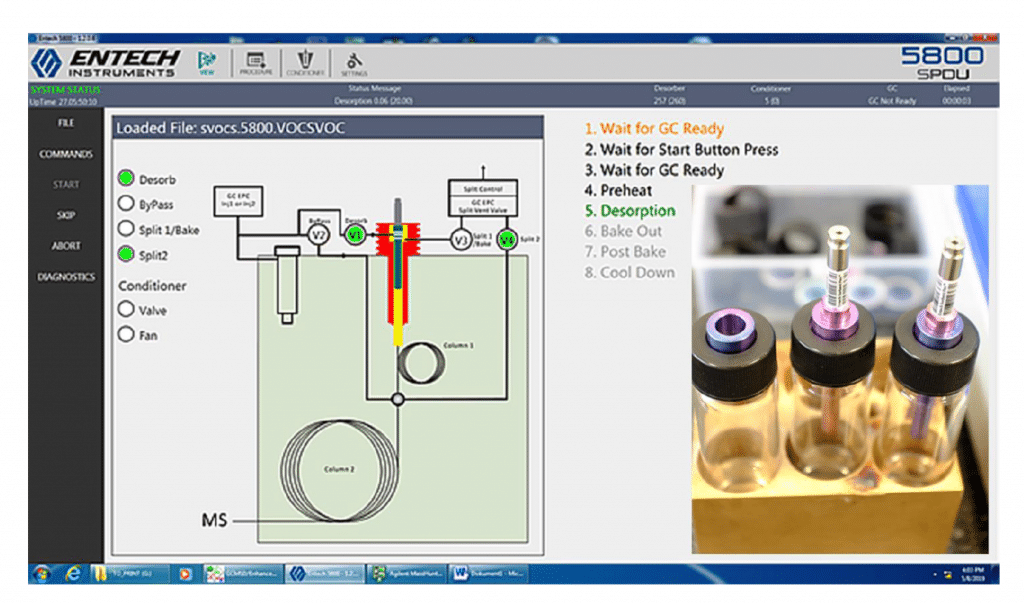
VASE system (left) and sorbent caps (right). Reprinted from: Jelen, Henryk, H, et al. Determination of volatile terpenes in coriander cold pressed oil by vacuum-assisted sorbent extraction. Molecules. 2021;26:884. License: CC BY 4.0
When finished, VASE extraction produced 17 main terpenes, with β-linalool being the most abundant. The next most represented were α-pinene, camphor, γ-terpinene, sylvestrene, β-pinene, and o-cymene.
Of utmost importance is how temperature affected the VASE process. Extractions performed at 60º C had peak areas nearly three times greater than those obtained at 20º C (with geraniol and geranyl acetate lifted most significantly by the higher temperature). However, researchers cautioned that prolonged elevation of temperatures would likely result in the loss of highly volatile terpenes, thus nullifying the effect of the cold press.
Compared to conventional hydrodistillation which contained higher quantities of monoterpene alcohols (e.g, β-linalool), VASE generated higher quantities of monoterpenes (e.g., sylvestrene).
Extraction with this method has various advantages. For one, VASE uses Sorbent Pens, which allow for quick desorption and do away with the need for cryofocussing (trapping in a cryotrap). Additionally, the process is completed rather quickly, within five minutes, and is environmentally friendly because the Sorbent Pens can be used multiple times (>100). Also, VASE is solventless. [1]
Image Source: Bhaba Mahato from Pixabay
Reference:
1: Jeleń HH, et al. Determination of volatile terpenes in coriander cold pressed oil by vacuum assisted sorbent extraction. Molecules. 2021;26:884. [Impact Factor: 4.411; Times Cited: n/a]